
select
Climate Change Management
Against the backdrop of increasing global climate change risks, the Company is well aware of the significant challenges that climate change may pose to its operations. These challenges could affect our supply chain, equipment operation, and employee safety, and may also pose a risk to overall operational stability. Therefore, we will continue to identify, assess, and manage these risks to reduce their potential impact on the Company’s operations and ensure sustainable development.
To address these risks, we have begun to strengthen our climate change adaptation measures and are actively referencing the Task Force on Climate-Related Financial Disclosures(TCFD)framework, with four core elements covered: “Governance”, “Strategy”, “Risk Management”, and “Metrics and Targets”. Through these guiding principles, we comprehensively identify the risks and opportunities that may impact our operations and take concrete actions to manage them appropriately, thereby fulfilling our commitment to sustainable operations.
Governance Unit

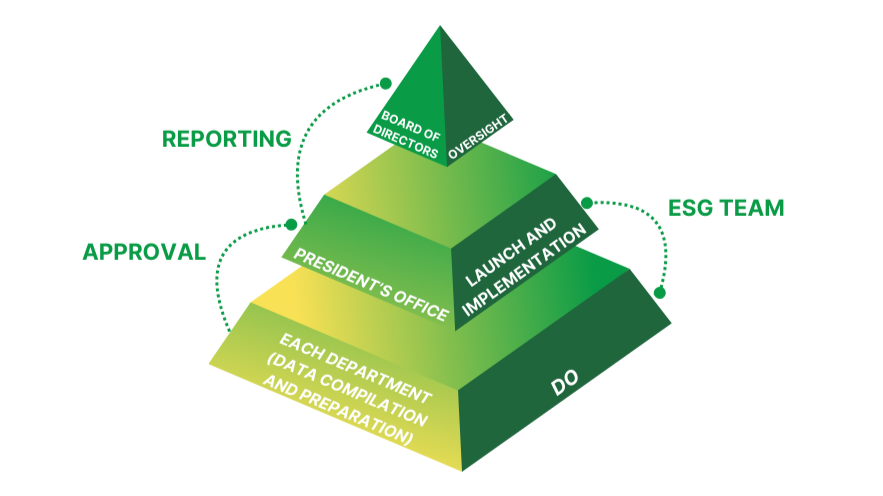
The Board is responsible for supervising and making decisions on climate-related issues to strengthen corporate operational resilience under climate change:
The task force is responsible for promoting and executing matters related to sustainable development. The management unit regularly identifies, assesses, prioritizes, monitors, and tracks climate risks (including physical and transition risks) and opportunities. It formulates measures to respond to extreme weather events and policy changes to ensure effective strategy implementation.
Before making major decisions, a climate impact assessment must be performed using both quantitative and qualitative analyses to reduce compliance and operational risks.
This enhances transparency and ensures compliance with local and international regulations (such as carbon fees and emission trading systems). In addition, through education, training, and communication, the Company ensures internal support for climate strategies and publicly discloses relevant achievements to investors and external stakeholders.
Strategy
Risk Management
ANPEC’s risk management not only includes contingency plans for risks that may impact financial performance, but also encompasses risk assessments and emergency response plans for natural disasters, environmental factors, and information-related risks. The concept of prevention is deeply embedded in the corporate culture to eliminate identifiable and avoidable risks as much as possible, thereby reducing the potential losses from operational disruptions.
Facing the occurrence of climate change risks, the Company employs a four-step process to manage climate risks and opportunities, ensuring consistency with financial and operational risks.
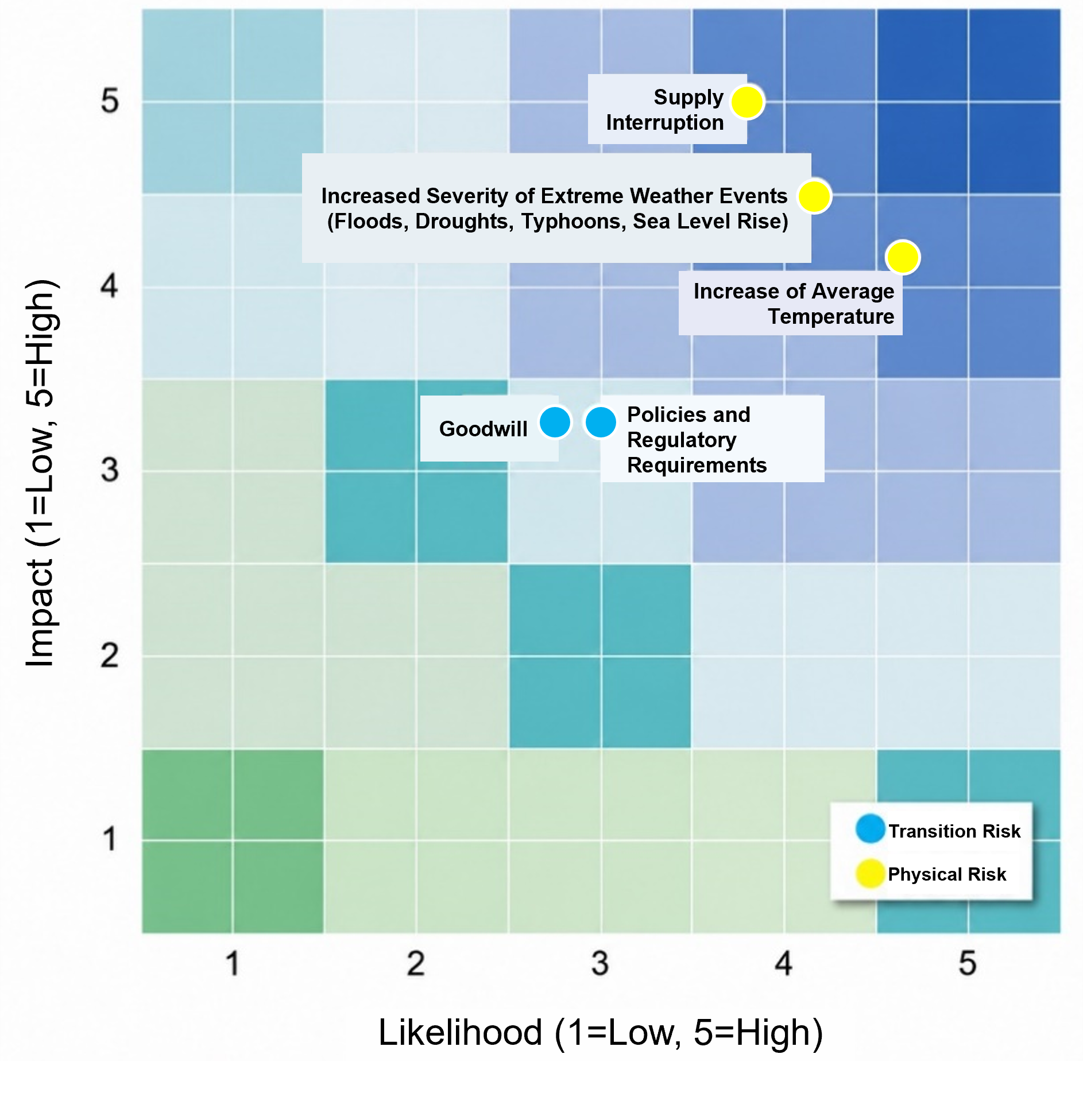
Through relevant departments’ participation and discussion, the identified climate change risks include transition risks (policy and legal, reputation), transition risks (supply disruptions, disasters caused by extreme climate change such as floods, droughts, and sea-level rise, and rising average temperatures), as well as climate opportunities (resource utilization and efficiency, shifts in market preference, attracting ESG investment, etc.).
The financial impact, probability, and timeframe of climate change risks on the Company’s overall operations have been evaluated. Based on internal risk assessment statistical results, a risk matrix has been established according to the degree of impact and probability, to prioritize highimpact and high-risk items for management. Response strategies and implementation measures have been proposed for each risk and opportunity, with continuous monitoring, tracking, and review to ensure policy implementation. Improvement results are reported to the President to ensure consistency with financial and operational risks.
In accordance with the requirements of IFRS S2, the Company discloses cross-industry climate-related metric information as follows:
In 2025, the Company’s total greenhouse gas emissions were 3,008.2635 metric tons of CO2e, of which Scope 1 (direct emissions) accounted for 5.59%, Scope 2 (energy indirect emissions) accounted for 52.19%, and Scope 3 (other indirect emissions) accounted for 42.22%. Compared to the baseline year of 2024, overall emissions for Scope 1, Scope 2, and Scope 3 in 2025 increased by 56.52%; the Company expects to achieve a 1% emission reduction target in 2026. Facing transition risks, the Company has formulated greenhouse gas reduction strategies and specific action plans. Simultaneously, the Company has established emission management and tracking mechanisms to regularly review target attainment, allowing for rolling adjustments and continuous refinements. In 2025, the Company did not adopt an internal carbon pricing mechanism as a planning tool. In the future, the Company will continue to monitor domestic and international carbon market prices, market trends, and relevant policies and regulations. Based on the Company’s own emission characteristics, it will evaluate whether to adopt such a mechanism as a reference for carbon reduction management and decision-making. Regarding remuneration policy, the Company is currently based on the existing performance evaluation system and has not yet incorporated performance indicators for climate-related risks and opportunities into the remuneration linkage mechanism. To actively respond to the risks and opportunities brought by climate change, the Company has established relevant climate indicators and emission reduction targets, covering carbon reduction, energy saving, and waste reduction, and regularly reviews changes in significant climate risks and opportunities. Furthermore, the Company has extended the scope of climate risk management to the supply chain, and works with partners to jointly promote environmental sustainability.
To address these risks, we have begun to strengthen our climate change adaptation measures and are actively referencing the Task Force on Climate-Related Financial Disclosures(TCFD)framework, with four core elements covered: “Governance”, “Strategy”, “Risk Management”, and “Metrics and Targets”. Through these guiding principles, we comprehensively identify the risks and opportunities that may impact our operations and take concrete actions to manage them appropriately, thereby fulfilling our commitment to sustainable operations.
Governance Unit
- Governance Level:
The Board is responsible for supervising and making decisions on climate-related issues to strengthen corporate operational resilience under climate change:
- Management Level:
The task force is responsible for promoting and executing matters related to sustainable development. The management unit regularly identifies, assesses, prioritizes, monitors, and tracks climate risks (including physical and transition risks) and opportunities. It formulates measures to respond to extreme weather events and policy changes to ensure effective strategy implementation.
- Supervision and Reporting Mechanism:
Before making major decisions, a climate impact assessment must be performed using both quantitative and qualitative analyses to reduce compliance and operational risks.
- Stakeholder Communication and Disclosure:
This enhances transparency and ensures compliance with local and international regulations (such as carbon fees and emission trading systems). In addition, through education, training, and communication, the Company ensures internal support for climate strategies and publicly discloses relevant achievements to investors and external stakeholders.
Strategy
Against the rising global risks of climate change, the Company is deeply aware of the potential major impacts on corporate operations, supply chain stability, and long-term competitiveness. Extreme weather events triggered by climate change may not only affect supply chain operations, equipment utilization, and employee safety but also pose substantial risks to the Company’s overall operational stability. To effectively manage these challenges, the Company has identified and disclosed climate-related risks and opportunities, as well as their potential impacts on operational strategies, business models, value chains, and financials (including cash flow and cost of capital), based on the framework of IFRS S2. The Company’s core business is IC design and sales, with a value chain spanning raw material supply, processing, logistics, and end-user sales. In recent years, the frequency of extreme weather has increased, and flooding events caused by heavy rainfall have become a significant source of operational risk for the supply chain.
Although the Company’s operational sites are located in higher-terrain areas with relatively limited direct exposure, the sites of raw material suppliers, foundries, and logistics partners may still face interruptions due to disasters, affecting delivery schedules and supply chain stability. Furthermore, if medium-to-long-term climate policies and carbon pricing mechanisms continue to tighten, including rising carbon fees and increased market demand for low-carbon products, supply chain operating costs will increase, placing transformation pressure on product strategies, manufacturing processes, and cost structures. The Company has completed the identification and assessment of physical climate risks (such as extreme weather and supply chain disruptions) and transition risks (such as policies and regulations, carbon costs, and reputation). It has determined that these relevant risks and opportunities will impact future cash flows, revenue, asset values, operating costs, capital expenditures, and financing capabilities. To ensure corporate resilience, the Company has conducted short-, medium-, and long-term financial impact analyses and formulated corresponding risk management measures and financial planning. At the same time, the Company continues to strive toward a low-carbon transition and the construction of supply chain resilience.
The Company also discloses indicators related to greenhouse gas emissions to assist investors in fully evaluating the enterprise’s sustainable development capabilities and long-term value.
Although the Company’s operational sites are located in higher-terrain areas with relatively limited direct exposure, the sites of raw material suppliers, foundries, and logistics partners may still face interruptions due to disasters, affecting delivery schedules and supply chain stability. Furthermore, if medium-to-long-term climate policies and carbon pricing mechanisms continue to tighten, including rising carbon fees and increased market demand for low-carbon products, supply chain operating costs will increase, placing transformation pressure on product strategies, manufacturing processes, and cost structures. The Company has completed the identification and assessment of physical climate risks (such as extreme weather and supply chain disruptions) and transition risks (such as policies and regulations, carbon costs, and reputation). It has determined that these relevant risks and opportunities will impact future cash flows, revenue, asset values, operating costs, capital expenditures, and financing capabilities. To ensure corporate resilience, the Company has conducted short-, medium-, and long-term financial impact analyses and formulated corresponding risk management measures and financial planning. At the same time, the Company continues to strive toward a low-carbon transition and the construction of supply chain resilience.
The Company also discloses indicators related to greenhouse gas emissions to assist investors in fully evaluating the enterprise’s sustainable development capabilities and long-term value.
| Risk/ Opportunity | Climate Related Events | Potential Financial Impact | Period | Response to the Strategy |
| Transition Risk | Policies and Regulatory Requirements |
|
Short-Term / Ongoing |
|
| Medium, and Long Term |
|
|||
| Transition Risk | Goodwill |
|
Medium, and Long Term |
|
| Physical Risk | Supply Interruption |
|
Short, Medium, and Long Term |
|
| Physical Risk | Increased Severity of Extreme Weather Events (Floods, Droughts, Typhoons, Sea Level Rise) |
|
Short, Medium, and Long Term
|
|
| Physical Risk | Increase of Average Temperature |
|
Short-Term/ Immediate |
|
|
Short-Term/ Immediate |
|
||
| Medium, and Long Term |
|
|||
| Climate Opportunities | Resource Utilization and Efficiency (Renewable Energy) |
|
Short-Term |
|
| Medium, and Long Term |
|
|||
| Climate Opportunities | Changes in Market Preferences |
|
Ongoing |
|
| Climate Opportunities | Attract ESG Investment |
|
Ongoing |
|
|
|
- Climate-Related Financial Risks and Opportunities
| FINANCIAL IMPACT | ||||
| CATEGORY | CLIMATE RISK/OPPORTUNITY TOPIC | REVENUE | COST/EXPENSE | CASH FLOW |
| Transition Risk | Policies and Regulatory Requirements | - | ▲ | ▼ |
| Transition Risk | Goodwill | ▼ | - | ▼ |
| Physical Risk | Supply Interruption | - | ▲ | ▼ |
| Physical Risk | Increased Severity of Extreme Weather Events | - | ▲ | ▼ |
| Physical Risk | Increase of Average Temperature | - | ▲ | ▼ |
| Climate Opportunities | Resource Utilization and Efficiency | - | ▼ | ▲ |
| Climate Opportunities | Changes in Market Preferences | ▲ | ▲ | ▲ |
| Climate Opportunities | Attract ESG Investment | ▲ | - | ▲ |
▲:Increase ▼:Decrease
ANPEC’s risk management not only includes contingency plans for risks that may impact financial performance, but also encompasses risk assessments and emergency response plans for natural disasters, environmental factors, and information-related risks. The concept of prevention is deeply embedded in the corporate culture to eliminate identifiable and avoidable risks as much as possible, thereby reducing the potential losses from operational disruptions.
Facing the occurrence of climate change risks, the Company employs a four-step process to manage climate risks and opportunities, ensuring consistency with financial and operational risks.
- Identification:Identify relevant risks and opportunities with reference to the Intergovernmental Panel on Climate Change (IPCC) Assessment Report.
- Assessment:Evaluate the opportunities, impacts, and financial shocks generated by climate change on the Company’s overall operations.
- Prioritization:Establish a risk matrix to prioritize management based on the level of risk impact and the probability of occurrence.
- Monitoring and Tracking:Monitor and track carbon emissions and energy use, and report the results to the governance unit.
Through relevant departments’ participation and discussion, the identified climate change risks include transition risks (policy and legal, reputation), transition risks (supply disruptions, disasters caused by extreme climate change such as floods, droughts, and sea-level rise, and rising average temperatures), as well as climate opportunities (resource utilization and efficiency, shifts in market preference, attracting ESG investment, etc.).
The financial impact, probability, and timeframe of climate change risks on the Company’s overall operations have been evaluated. Based on internal risk assessment statistical results, a risk matrix has been established according to the degree of impact and probability, to prioritize highimpact and high-risk items for management. Response strategies and implementation measures have been proposed for each risk and opportunity, with continuous monitoring, tracking, and review to ensure policy implementation. Improvement results are reported to the President to ensure consistency with financial and operational risks.
In accordance with the requirements of IFRS S2, the Company discloses cross-industry climate-related metric information as follows:
In 2025, the Company’s total greenhouse gas emissions were 3,008.2635 metric tons of CO2e, of which Scope 1 (direct emissions) accounted for 5.59%, Scope 2 (energy indirect emissions) accounted for 52.19%, and Scope 3 (other indirect emissions) accounted for 42.22%. Compared to the baseline year of 2024, overall emissions for Scope 1, Scope 2, and Scope 3 in 2025 increased by 56.52%; the Company expects to achieve a 1% emission reduction target in 2026. Facing transition risks, the Company has formulated greenhouse gas reduction strategies and specific action plans. Simultaneously, the Company has established emission management and tracking mechanisms to regularly review target attainment, allowing for rolling adjustments and continuous refinements. In 2025, the Company did not adopt an internal carbon pricing mechanism as a planning tool. In the future, the Company will continue to monitor domestic and international carbon market prices, market trends, and relevant policies and regulations. Based on the Company’s own emission characteristics, it will evaluate whether to adopt such a mechanism as a reference for carbon reduction management and decision-making. Regarding remuneration policy, the Company is currently based on the existing performance evaluation system and has not yet incorporated performance indicators for climate-related risks and opportunities into the remuneration linkage mechanism. To actively respond to the risks and opportunities brought by climate change, the Company has established relevant climate indicators and emission reduction targets, covering carbon reduction, energy saving, and waste reduction, and regularly reviews changes in significant climate risks and opportunities. Furthermore, the Company has extended the scope of climate risk management to the supply chain, and works with partners to jointly promote environmental sustainability.

If you have any questions about sustainable operation, please contact us.
IR

E-mail : IR@anpec.com.tw
Tel : +886-3-564-2000
Address : No.6, Duxing 1st Rd., Hsinchu Science Park, Hsinchu City 300096, Taiwan (R.O.C.)
Office Hour : 8:30 AM ~ 5:30 PM
Securities Agent

Taishin Securities Corp., Ltd.
(Securities Agent)
Tel : +886-2-2504-8125
Fax : +886-2-2501-3452
Address : B1, No. 96, Section 1, Jianguo N. Rd., Zhongshan Dist., Taipei City
Office Hour : 8:30 AM ~ 4:30 PM
Website: https://www.tssco.com.tw
IR
E-mail : IR@anpec.com.tw
Tel : +886-3-564-2000
Address : No.6, Duxing 1st Rd., Hsinchu Science Park, Hsinchu City 300096, Taiwan (R.O.C.)
Office Hour : 8:30 AM ~ 5:30 PM
Securities Agent
Taishin Securities Corp., Ltd.
(Securities Agent)
Tel : +886-2-2504-8125
Fax : +886-2-2501-3452
Address : B1, No. 96, Section 1, Jianguo N. Rd., Zhongshan Dist., Taipei City
Office Hour : 8:30 AM ~ 4:30 PM
Website: https://www.tssco.com.tw